Bio+Hx
[H abitat
+ x initiative]
The BioHx initiative:
Bio-Architecture, Bio-Materials & Bio-Design
ACEAA explores the intersections between architecture, design, ecology and emerging forms
of environmental interaction. Our work focuses on how spatial practices can contribute to
more sustainable, biodiverse and inclusive ways of inhabiting.
Rather than understanding architecture and design as isolated human activities, we approach
the built environment as part of broader ecological systems involving materials, organisms,
technologies and social communities. Through research, experimentation and collaborative projects,
we investigate new relationships between space, matter, perception and living systems.
This work is articulated through three interconnected fields:
Bio-Architecture -
Bio-Materials - Bio-Design
Bio-Architecture
Bio-Architecture investigates how architectural practice can respond to ecological, climatic and social challenges through regenerative approaches to space, construction and inhabitation.
At ACEAA, Bio-architecture is understood not only as an environmental strategy, but as a broader way of rethinking the relationship between buildings, landscapes, resources and living systems.
Our approach includes:
- sustainable and low-impact construction;
- passive environmental strategies;
- circular approaches to building processes;
- biodiversity-sensitive design;
- integration of vegetation and habitat systems;
- adaptive reuse and transformation of existing structures;
- participatory and socially inclusive spatial practices;
- more-than-human approaches to architecture and urban environments.
Bio-architecture therefore moves beyond conventional sustainability by considering architecture as part of a dynamic ecological network in which humans, non-human species, materials and environmental processes coexist.
Bio-Materials
Bio-Materials play a fundamental role in the ecological transformation of architecture and design.
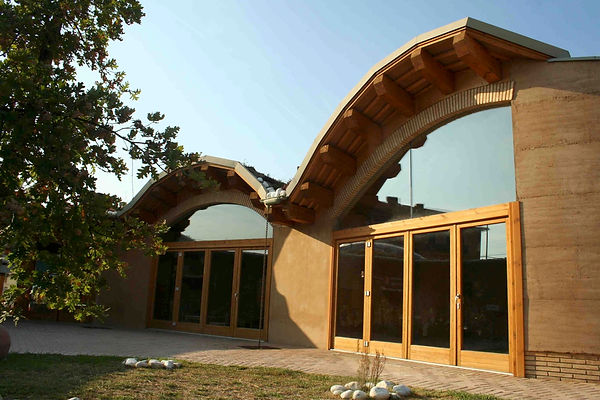
ACEAA explores biomaterials and low-impact material systems as tools for reducing environmental impact while developing new aesthetic, spatial and cultural possibilities.
Our interests include natural, renewable, recycled and bio-based materials, as well as experimental material systems that challenge conventional industrial production.
Research and experimentation may involve:
- earth-based construction;
- timber and plant-based materials;
- mycelium and bio-fabricated materials;
- recycled and reclaimed materials;
- low-carbon composites;
- biodegradable systems;
- circular material processes;
- locally sourced materials and vernacular construction knowledge.
Rather than considering materials only as technical components, we understand them as active participants in the spatial and ecological performance of architecture and design.
Biomaterials therefore connect construction, environmental responsibility, sensory experience and material culture.
Bio-Design
Bio-design explores new relationships between design, biology, technology and ecological systems.
It investigates how design can move beyond the production of objects and environments for exclusively human use, and instead engage with living systems, multispecies relationships and dynamic environmental processes.
At ACEAA, biodesign is approached as an interdisciplinary field connecting architecture, interaction design, digital technologies, ecological research and artistic experimentation.
Our work explores questions such as:
- How can design respond to the perceptual worlds of other species?
- Can interactive environments reveal ecological relationships that normally remain invisible?
- How can digital technologies contribute to new forms of environmental awareness?
- What happens when humans are no longer considered the only users of designed spaces?
- How can design contribute to forms of coexistence between biological and technological systems?
Bio-design becomes, in this sense, a space for experimentation between science, art, architecture and emerging technologies.
More-than-Human Interactive Spaces
Designing interfaces between human perception, technological systems and other forms of life.
Within our biodesign research, ACEAA develops a specific line of investigation focused on More-than-Human Interactive Spaces. This approach explores interactive environments that move beyond conventional human-centred design.
Most interactive systems are designed to respond exclusively to human bodies, gestures and behaviours. More-than-human interaction asks a different question: what happens when the perceptual, behavioural and ecological worlds of other species become part of the design process?
Through digital sensing, real-time visualisation, behavioural models and spatial interfaces, interactive environments can become laboratories for exploring relationships between human perception and other forms of life. Rather than attempting to simulate or reproduce the experience of another species, these environments aim to create a third perceptual field: a hybrid space emerging from the interaction between human behaviour, technological mediation and biological models.
This research connects:
- interaction design;
- spatial design;
- multispecies studies;
- biosemiotics;
- digital environments;
- behavioural modelling;
- environmental sensing;
- artistic research.
The objective is not simply to represent nature digitally, but to investigate how interactive technologies can transform our understanding of coexistence, perception and ecological interdependence.
Wirkraum — The Space That Remembers
Wirkraum is an experimental interactive environment exploring the relationship between human movement, digital perception and models inspired by animal spatial behaviour.
The project investigates how interaction design can move beyond direct human–machine feedback and generate hybrid perceptual environments informed by more-than-human modes of orientation and spatial memory.
Using real-time sensing and generative digital systems, the installation transforms human presence into a dynamic spatial field whose behaviour is informed by biological models rather than by direct visual representation.
Wirkraum functions as an experimental platform for the development of more-than-human interactive design.